
Archaeological Ruins
Veracruz, Mexico
Travel & Tour
Pictures, Photos, Information, Images & Reviews.
George & Eve DeLange
Google Map To Zempoala (Cempoala).
Archaeological Ruins, Veracruz, Mexico.

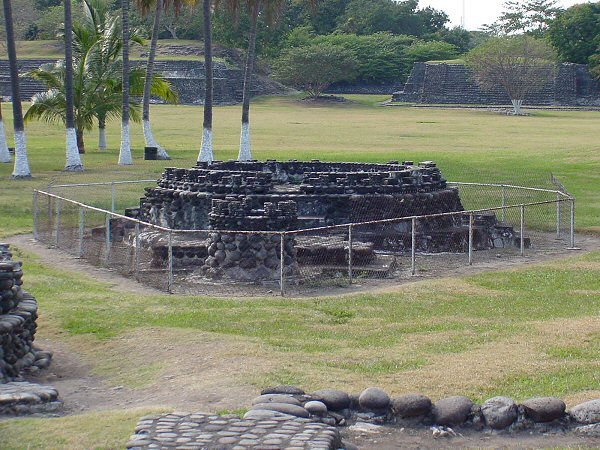
Zempoala Archaeological Ruins, Veracruz, Mexico: The name means "place of the 20 waters," for the several rivers that converge near the site. At the time of the Conquest, Zempoala (also spelled "Cempoala") was the Totonac capital and the largest city on the Gulf of Mexico, with a population of about 30,000. Zempoala was the first large Mesoamerican center visited by Europeans and the place where Cortes met his first important native ally, "Xicomecoatl", better known as the "Fat Chief." Only a small part of the main ceremonial area of the site has been restored. Zempoala is an important place where history was made. The uniting of Spanish, European, and the Native American cultures that became modern Mexico could be said to have their beginnings in Zempoala. Most of the buildings at Zempoala date from the 14th and 15th centuries,during the Late Post-Classic Era. The area was populated at least 1,500 years earlier and there are indications of an Olmec influence. The Preclassic settlements were built on mounds to protect them from floods. Not much is really known about what went on during the Preclassic and Classic Era The Great Temple resembles the Temple of the Sun at Tenochtitl�n. The Temple of the Little Faces is decorated with stuccoed faces in the walls and hieroglyphs painted on the lower sections. The Temple of Quetzalcoatl, the feathered serpent god, is a square platform, and the Temple of Ehecatl, god of the wind, is round which is normal. Zempoala lies on the flat coastal plain about six kilometers from the Gulf and a little more than a kilometer from the banks of the Rio Actopan River (also called the Rio Chachalacas). The Totonacs moved onto this coastal plain during the height of the Toltec empire (A.D. 1000-1150). Archaeologists believe the Toltecs had pushed the Totonacs out of their settlements on the eastern slopes of the Sierra Madre Oriental and down to the coast. In the mid-15th century, Zempoala and many other coastal Veracruz centers were attacked and defeated by the Aztec armies of Motecuhzoma 1. They were assessed a heavy tribute in both goods and victims for sacrifice. This treatment at the hands of the Aztecs created the situation which led up to the defeat of the Aztecs by Cortez in the 16th century. By the time Cortes and his forces arrived on the Veracruz coast in 1519, the Totonacs had been suffering for several years under the Aztec domination. As the Spaniards marched north from their malaria-ridden first camp at San Juan de Ulua" they heard of a town on the way named Zempoala. They sent word of their impending arrival, and they were met on the outskirts of town by 20 Zempoalan dignitaries. In the center of town, they met with the "Fat Chief, Xicomecoatl", who fed them and gave them quarters. After the Totonac presented Cortez with numerous gifts, including gold jewelry, Cortez how he could repay this hospitality. Xicomecoatl is said to have heaved a deep sigh and broke into many bitter complaints against the great Montezuma. Cortez then promised to consider the matter and the next day Cortez departed for Quiahuiztlan, where the Spaniards and Totonacs then forged their momentous alliance against the Aztecs. The Totonacs were now committed to the same fate as the Spaniards'. In August of 1519, Cortez and his men set out with 40 Totonac warriors and 200 porters for the Aztec capital of Tenochtitlan. During the next few months, they won one victory after another through both force and guile. They eventually ended up in the heart of Tenochtitlan with Motecuhzoma II, the Aztec emperor, as their hostage. When we toured the site we were able to observe some of the major sights of the ceremonial precinct. Beyond this area, however, there are dozens of temples. Paths into the sugarcane fields to the north and east lead into several secondary precincts which we did not visit which contain numerous structures, some of which have been restored. The so-called Temple of Charity standing about 200 meters to the east is a two-tier structure decorated with fragments of stucco reliefs. It is named for the hundreds of stucco skulls that once adorned the facade of a small structure at the base of the temple's staircase-archaeologists believe this complex was dedicated to the god of death. More, largely unexcavated, mounds that we did not visit lie among the houses in the town of Zempoala. Some of the humbler structures here are built in the same style-thatched roof and wood and adobe walls as were the residences of the pre-Hispanic proletariat. Some research by Vincent H. Malmstr�m of Dartmouth College describes an interesting astronomical relationship that exists because of the three round rings found at Zempoala. We will quote a part of his discussion concerning the Three Ceremonial Rings Of Zempoala. "In the central plaza of Zempoala, just beneath the massive pyramids that frame its northeastern corner, are three intriguing rings of stone, each fashioned of rounded beach cobbles cemented together to form a series of small, stepped pillars. The largest of the rings contains 40 of the stepped pillars, the middle-sized ring has 28 such features, and the smallest ring numbers 13 stepped pillars around its circumference. It would appear that the three rings were used to calibrate different astronomical cycles, possibly by moving a marker or an idol from one stepped pillar to the next with each passing day (in somewhat the same way that has been suggested for recording the passage of time at the Pyramid of the Niches). The three stone rings of Zempoala as viewed from the top of the main pyramid. Inasmuch as the three rings are surmounted by 13, 28, and 40 steplike pillars, respectively, it appears that they were used by the Totonac priests as counting devices to keep track of eclipse cycles. It is, therefore, quite possible that by using the three rings together, the Totonac priests were able to calibrate the movements of the moon closely enough so as to know when it might next be (devoured.) In any event, there is every reason to believe that the three stone rings of Zempoala afford yet another bit of evidence testifying to the intellectual curiosity and architectural ingenuity of the early Mesoamericans." The museum, and restrooms are clean. We were here on January 21, 2004 at about 2:30PM.
|
You can fly near to Zempoala by flying into the General Heriberto Jara International Airport, also called the Veracruz International Airport (IATA: VER, ICAO: MMVR) which is the international airport located at Veracruz, Veracruz, Mexico. It handles national and international air traffic for the city of Veracruz. Zempoala is about 26 miles northwest of Veracruz City. There is also bus service from Veracruz to Zempoala, (also written as Cempoala). We suggest getting a hotel in Veracruz and then letting them arrange either a car or a tour of Zempoala. If you call their Concierge Services ahead of your arrival, all of this can be pre-arranged for you. We do this all the time, when traveling in Mexico. It is safe and it works!!! We have never experienced a problem doing it this way! We have links to Priceline.com on this page so you can make your flight and hotel arrangements.
|

 |
| The Largest Of "The Three Ceremonial Rings Of Zempoala" It Is Said That Cortez And His Men Camped Inside This Ring |
|---|
 |
| The Smaller Two Of "The Three Ceremonial Rings Of Zempoala" The Three Rings Are In The North East Corner Of The Pyramid Complex |
|---|
 |  |
| The Official Site Entrance Located On South Side Of The Excavated Area | Grocery Store And Gift Shop Across Street From Site Entrance |
|---|---|
 |  |
| Zempoala Site Museum On Left | View Of Museum & Large Stone Ring |
 |  |
| Looking NE Into Grand Plaza From NE Of The Museum | Pyramids In NE Corner Of Plaza |
 |  |
| Platform Running North And South Of "Temple Of The Chimney's" | Platform Running North And South Of "Temple Of The Chimney's" |
 |  |
| Looking NW Across Grand Plaza From NE Corner | North Pyramid Called "Great Temple" |
 |  |
| Great Temple Located Center North End Of Quadrangle | Great Temple Is Oldest Most Importand Temple Also Panfil Narvaez Fought Cortez Here |
 |  |
| East Of "Great Temple" Is Audrey DeLange On Top Of "Temple Of The Chimney's" | South Side "Temple Of The Chimney's" Rock Structures On Top Look Like Chimney's |
 |  |
| SE Corner "Temple Of The Chimney's" | Original Stucco On The South Side "Temple Of The Chimney's" |
 |  |
| Stone Columns Look Like Chimneys Top Of "Temple Of The Chimney's" | Floor Structure "Temple Of The Chimney's" |
 |  |
| Rectangular Platform & Four Columns In Front Of "Temple Of The Chimney's" | Stairway On West Side Front Of "Temple Of The Chimney's" |
 |  |
| Altars In Front Of And West Of "Temple Of The Chimney's" | This Altar Is Probably Aligned To The Winter Solstice |
 |  |
| Stairway Over Protective Wall Surrounding The Zempoala Quadrangle | The Surrounding Wall Protects Quadrangle Area From Floods Of The Rio Actopan |
 |  |
| The Quadrangle And Great Pyramid Make A Left When Walking Past The Museum | Great Pyramid Is Located In SW Corner Of The Quadrangle This Other Pyramid Is North Of Great Pyramid |
 |  |
| Temple Of The "Wind God" Located South Of Great Pyramid | Wind God Temple |
 |  |
| Small Structure NW Corner Of Quadrangle | Closer View Of Small Structure |
We Are Proud Of Our SafeSurf Rating!

Click On Any Of The Following Links By Amazon.Com
For Books Or Videos About Touring In Mexico. No Obligation!
Click On The Bottom Link Marked GO, Then Look At The Bottom Of The Page That Comes Up.
There You Will See Travel Agencies That Are Recommended By Amazon.Com
For Touring In Mexico. No Obligation!
Here Are Some Links To The Very Best & Most Popular Items Sold On Amazon.Com
To Learn More! Click The Links Below. No Obligation, Of Course!
Other Nearby Veracruz, Zempoala &
Quiahuiztlan Archaeological Site Pages!
There You Will See Travel Agencies That Are Recommended By Amazon.Com
For Touring In Mexico. No Obligation!
Here Are Some Links To The Very Best & Most Popular Items Sold On Amazon.Com
To Learn More! Click The Links Below. No Obligation, Of Course!
Other Nearby Veracruz, Zempoala &
Quiahuiztlan Archaeological Site Pages!