
Mexico City D.F. Mexico
Travel & Tour
Pictures, Photos, Information, Images, & Reviews.
The "Great Temple" Page Three.
George & Eve DeLange
Google Map To Templo Mayor (Tenochtitlán). Mexico City D.F. Mexico.

View Larger Map
The Aztec city of Tenochtitlán (Teh-no-Chtiht-Laan), was built on an island in Lake Texcoco, the site of present-day Mexico City. There is an interesting story about how the great city was founded. Legend says that their god of war, Huizilopochtli, told his people about the place where the city was to be established. He said it would be a place where they would find an eagle on a nopal (cactus) eating a snake. Legend says that the Aztec's came from Aztlan (an area located at the North-East of current Mexico). Thus, the symbol on the flag of Mexico. The Templo Mayor is dedicated to the god of water and the rain, Tlaloc, and the god of the War, Huitzilopochtli. It is the double pyramid which was probably largest and most significant of all prehispanic constructions. Also, parts of the Templo Mayor are describing the story of the birth of the god of war, Huitzilopochtli. In fact the pyramid is a representation of Snake Mountain and stones representing the slain mother and sister of the god of war, Huizilopochtli are at the bottom of the pyramid. According to a legend recorded by the Colonial Spanish friar and ethnographer Bernardino de Sahagún, there once lived an old woman named Coatlicue, or Lady Serpent Skirt, together with her daughter, Coyolxauhqui, and her four hundred sons at Coatepec (Snake Mountain). One day as Coatlicue was attending to her chores sweeping the summit of Snake Mountain, she gathered up a mysterious ball of feathers and placed them in the sash of her belt. Miraculously, she found herself with child. But when her daughter Coyolxauhqui ("Koh-yowl-shau-kwee"), saw what had happened she was enraged and shreiked to her siblings “My brothers she has dishonored us! Who is the cause of what is in her womb? We must kill this wicked one (mother) who is with child!” When Coatlicue heard what her children were plotting she was frightened. But the child (Huitzilopochtli) who was in her womb called to her saying: “Have no fear mother for I know what to do.” The 400 sons each went forth. Each wielding his weapons and Coyolxauhqui led them. At last they scaled the heights of Coatepec. At this point there are many variations to the story but it appears that when Coyolxauhqui and her four hundred brothers reached the summit of Coatepec they immediately slew their mother, Coatlicue. When they cut off her head the blood spurt forth from her neck in the form of two gigantic serpents. Then Huitzilopochtli whose name means “hummingbird on the left”, was born in full battle array with his shield and spear thrower. Suddenly he pierced Coyolxauhqui with a spear and then he struck off her head. Her body then twisted and turned as it fell to the ground below Snake Mountain. Then the sun god, Huitzilopochtli took on the four hundred brothers and slew each of them. An illustration from the 16th century Florentine Codex shows Huitzilopochtli standing at the summit of Coatepec killing Coyolxauhqui and her 400 brothers. We have included a copy for you to see. The importance of fauna in the ritual life of the Mexicas is manifest in the Great Temple, in the architecture as well as in the offerings. Different species of serpents were represented in the architecture of the building, decorated with symbolic elements like feathers, perforated discs, and spirals. On the four facades of the platform there are monumental heads sculpted in basalt. Two enormous serpents with undulating bodies, measuring six meters in length, flank the entrance to the platform. The serpents' heads embedded in the pyramid base have been interpreted as evocations of the Hill of Coatepec, the birthplace of Huitzilopochtli. In the center of the Phase IVb platform, we find the Altar of the frogs. When these amphibians croaked, they were announcing the coming of the rainy season. During the month of the fiesta honoring the maize goddess Tozoztontli, the frogs were dressed in blue, and then sacrificed and cooked. The Mexica architects designed the Great Temple as their model of the center of the universe, where the horizontal plane converged with the vertical plane. The horizontal plane was aligned with the four cardinal points or directions of the universe. The Great Temple was located at the point where these two axes crossed. On the vertical plane there were three celestial levels, the earth, and the nine levels of the underworld. On February 28, 1978, workers digging to the east of the cathedral struck an immovable stone. When unearthed, it was found to have the dismembered figure of the moon goddess Coyolxauqui, sister to Huitzillopochtli. She was decapitated by her brother, Huitzillopochtli, the sun. This stone positively identified this as the ancient site of Teocalli, which was earlier believed to be buried beneath the Catedral Metropolitana. When you visit the site, two main structures stand out from the rest of the site. They are the "Great Temple" and the "House Of The Eagles". Of course, there are many other interesting structures that will also draw your attention. This page is devoted to The Great Temple. On our next page we will feature the "Casa de los Caballeros Aguila", "House of the Men-Eagle", which once housed an ancient order of elite warriors. Regarding the construction techniques of the Mexicas and the Aztecs: There were problems related to the muddy subsoil at Tenochtitlán, combined with the problem of the flooding that occurred when the lakes rose forced the Mexicas to adopt very special construction techniques. The foundations were made by driving stakes from the ahuejote tree into the lake bed or into an island fortified with fragments of tezontle stone and mud. Thus the ground was prepared for laying the foundations, which consisted of a nucleus of earth and volcanic rock. This technique was so effective that the Spaniards adopted it in their first buildings. We will enclose two photos of this building technique on this page. Another legend suggests that the temple is constructed on top of two caves that are filled with a primordial water, home to Huitzilopochtli, the ancient god of fire and lord of time who occupied the center of the earth. This has not been proven but if it were true it could be said that the Aztecs also honored sacred space in building their pyramid over a cave.. Between the "House Of The Eagles" and "The Great Temple" is Building B, "The Tzompantli Altar." It is made up of rows of 240 stone skulls, covered with several layers of stucco, decorate the rear and side facades of the Building. The main facade has a stairway with a low stone railing on each side. One of the most spectacular offerings of all are found inside the building, consisting of representations of musical instruments and two wolf skeletons, among other objects. The Tzompantli Altar is located to the north of the Great Temple, symbolic of the region of the dead or Mictlampa, according to the Mexica vision of the cosmos. Another interesting building in the same general area is the "Templo Rojo Norte" or Building C. This temple was built according to the construction system known as talud and tablero (sloping wall and panel), revealing the influence of Teotihuacán. The main facade is composed of a vestibule with a circular altar in the center. The space is bordered by walls adorned with large red stone circles and red and white moldings, at the back we see the small temple, totally painted with designs in red, yellow, blue, black, and white. This building is characterized by its murals painted on stucco, with high-quality, well-conserved designs.
|
The Mexico City International Airport (Spanish: Aeropuerto Internacional de la Ciudad de México or AICM), also called Benito Juárez International Airport (IATA: MEX, ICAO: MMMX) is the major commercial airport that serves Mexico City, the capital of Mexico. It is also Mexico's and Latin America's busiest airport!
There are many very good hotels and motels in the area, and if you need a place to stay; Priceline.com can arrange that for you. In fact, we think they are the best way to do it! We have personally, booked flights, hotels, and vacations, through Priceline.com and we can highly recommend them. Their website is very easy to use! We have some links to Priceline.com on this page, since they can arrange all of your air flights, hotels and car. We of course, appreciate your use of the advertising on our pages, since it helps us to keep our pages active. We also have links on this page, that will connect you with several of the best hotels in Mexico City. Hotels that we have personally used! We could, also suggest getting a hotel, and then letting them arrange for either a car, or a tour of Mexico City. If you call their Concierge Services, ahead of your arrival, all of this can be pre-arranged for you. We have used this method, many times, when traveling in Mexico. We have found it to be safe and it works!!! We have never experienced a problem, doing it this way!
|
| Templo Mayor From The Entrance ( Tenochtitlán ) Mexico City Great Temple Under Green Roof Near Top Center, House Of The Eagles In Far Left Background, Under Green Roof In Front Of The Pink Building, Looking Toward Northeast |
|---|
| The "Great Temple", Templo Mayor ( Tenochtitlán ) Mexico City House Of The Eagles In Far Left Background, Under Green Roof In Front Of The Pink Building, Looking Toward Northeast Note The Covers Over The Serpants Leading Up The Great Pyramid |
|---|
| East Temple Of The "Great Temple" Templo Mayor ( Tenochtitlán ) The Western Steps Leading Up Are On The Right (West) Of This Structure The Steps Are Not In This Photo, We are Looking Southeast |
|---|
| Western Steps Of The "Great Temple" Templo Mayor ( Tenochtitlán ) Mexico City, These Are The Great Temple Steps That Led Up To The Top Most Of The Temple Was Destroyed By The Spanish Conquistadores We Are Looking South |
|---|
 |
| Behind The "Great Temple." Templo Mayor ( Tenochtitlán ) Mexico City Looking South SouthWest, Photo From Top of Museum |
|---|
 |
| Behind The "Great Temple." Templo Mayor ( Tenochtitlán ) Mexico City Looking West, Photo From Top of Museum |
|---|
 |
| Florentine Codex Shows Huitzilopochtli Standing At Summit Of Coatepec Killing Coyolxauhqui And Her 400 Brothers |
|---|
| Sketch Of Great Temple. |
|---|
| Remains Of The Great Temple, The Original Temple Was 90 Feet Tall The Highest Parts Were Destroyed So The Government Of Spain Could Impose Catholicism Upon The People |
|---|
| Templo Mayor Air Photo Showing Cardinal Directions | Templo Mayor Aerial Photo Showing Cardinal Directions |
|---|---|
| Steps Leading To Great Temple | Decorated Steps |
| Steps Leading To Great Temple Under The Green Shed | The Part Of Great Temple Circled Is What You See Under The Green Shed |
| Serpent Replica On Great Temple | Serpent Replica On Great Temple |
| Replica Of Dismembered Moon Goddess Coyolxauqui Sister To Huitzillopochtli Original In Museum | (Original) Coatlicue Mother Of Huitzillopochtli On Coatepec (Serpent Mountain) |
| Great Temple. Templo Mayor | Choc Mool |
| Choc Mool At North Part Of The Great Temple Dedicated To Tlaloc The God Of Water And Rain | Human Sacrifice Stone On South Side Great Temple Dedicated To Huitzilopochtli God Of War |
| Division Pillars Of The Two Temples Of The Great Temple | Tlaloc Temple |
| North Side Of Tlaloc Temple | South Side Of Tlaloc Temple |
| Great Temple. Templo Mayor | Great Temple. Templo Mayor |
| Great Temple. Templo Mayor | Great Temple. Templo Mayor |
| Serpent Heads | Serpent Heads |
| Serpent Head Detail | Great Temple. Templo Mayor |
| Three Buildings Between Great Temple And House Of The Eagles | Known As Buildings A, B, And C Building A In Front, Building C Under Green Shed In Back |
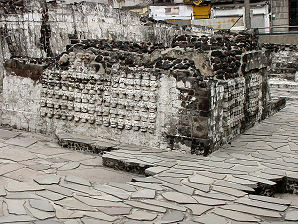 | |
| Building B, Tzompantli Altar Decorated With 240 Human Skulls Made Of Stone | Building B, Tzompantli Altar Decorated With 240 Human Skulls Made Of Stone |
| Building C, North Red Temple | Building C, North Red Temple |
| Building C, North Red Temple | Building C, North Red Temple |
| Ahuejote Tree Stakes Building Technique | Ahuejote Tree Stakes Building Technique |
| Colonial Period Drain | Statues On West Steps |
| Building D | Building D Fountain |

We Are Proud Of Our SafeSurf Rating!
Click On Any Of The Following Links By Amazon.Com
For Books Or Videos About Touring In Mexico. No Obligation!