
Diego Rivera Murals.
Mexico City D.F. México
Travels & Tours
Pictures, Photos, Images, & Reviews.

George & Eve DeLange
Google Map To The Palacio Nacional. On East Side Of The Zócalo. Mexico City D.F. México.

View Larger Map
We Are Proud Of Our SafeSurf Rating!

We have placed a series of large photos of some of Diego Rivera's work that can be found in the National Palace of Mexico City upon this page. This building is now housing the Secretary Of Public Education of Mexico City, or Secretaría de Educación Pública, Ciudad de México. We have tried to show accurate descriptions of each photo just below the image. A brief description of Diego Rivera will follow the images. These large pictures were taken at the National Palace of Mexico City on November 22, 2011.
|
 |
| Mural ( 1929 - 1945 ) by Diego Rivera: "Exploitation of Mexico by Spanish Conquistadors." Palacio Nacional. Mexico City D.F. México. November 22, 2011. |
|---|
 |
| "Totonac Civilization, El Tajin." 1950 by Diego Rivera. Palacio Nacional. Mexico City D.F. México. November 22, 2011. |
 |
| "The Great City of Tenochtitlan." 1945 by Diego Rivera. Palacio Nacional. Mexico City D.F. México. November 22, 2011. |
 |
| "The Zapotec and Mixtec Civilization." 1945 by Diego Rivera. Palacio Nacional. Mexico City D.F. México. November 22, 2011. Here we see the Zapotec and Mixtec cultures in the state of Oaxaca who developed the art of designing with feathers as well the art of jewelry making with fine metals. In the background, the people are panning for precious metals. Probably, gold? In the right foreground the use of metal technology is shown. The official museum guide says that they used the lost wax method. In the Grisailles underneath the polychrone panel, we can see from left to right:: mining; carving; & the jade trade. |
 |
| "The Tarascan & Purepechan Culture Of Michoacan." 1945 by Diego Rivera. Palacio Nacional. Mexico City D.F. México. November 22, 2011. This scene many important cultural developments. In the background fishermen are useing butterfly nets, native people are harvesting cotton, as well as, cochineal from the nopal cactus to produce the red dye for the elite or to be shipped to the royals of the "old world". In the middle ground, a large building with a complex roof is being built and immediately behind it, miners are extracting coal from the side of a cliff. In the foreground dyers are tinting cloth and hanging it to dry. Artists are painting a topographic map. Another elaborately dressed and tattooed standing man is holding up a beautiful codex. The Volcanoes and Lake Patzcuaro are in the far distance. Also, in the grisailles, underneath the polychrone panel, we can see from left to right: artists dying cloth, with either one or both species of two purple snails, either the muricid, Plicopurpura pansa, or sometimes the thaid, Thais kiosquiformis. Also in the grisailles, sculptors, and ceramicists; can be seen tattooing. |
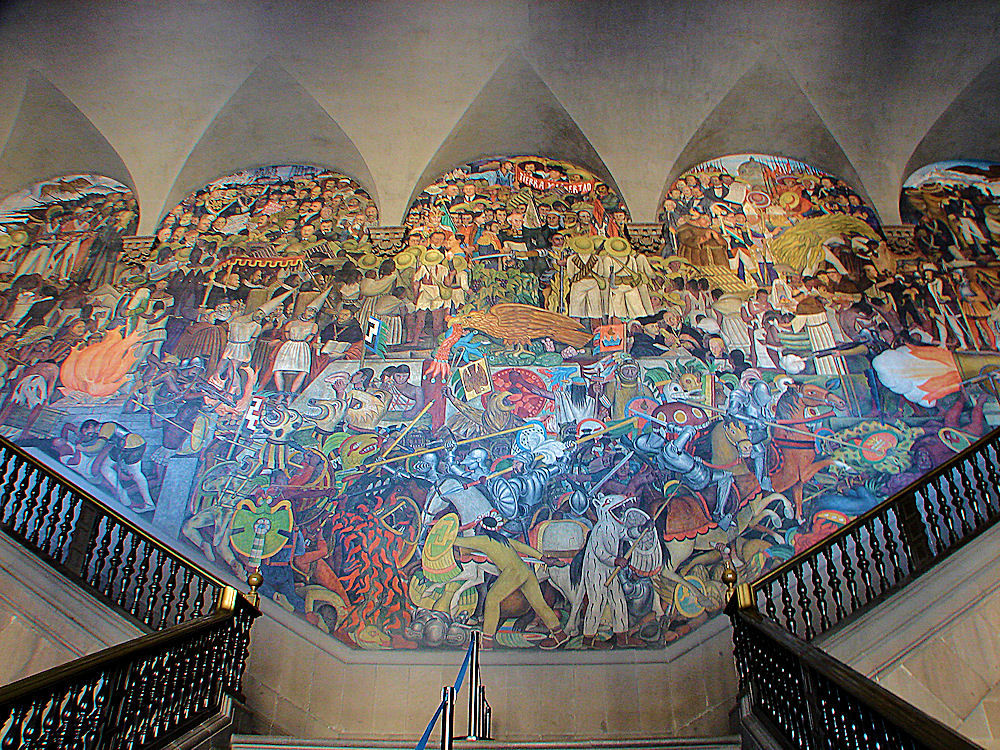 |
| Mural ( 1929 - 1945 ) by Diego Rivera: "Part Of Diego Rivera's Mural Depicting Mexico's History." Also Called: "México en la historia, perspectiva: El campesino oprimido, 1935. Near Left Staircase. Palacio Nacional. Mexico City D.F. México. November 22, 2011. |
|---|
 |
| Mural ( 1929 - 1945 ) by Diego Rivera: "Part Of Diego Rivera's Mural Depicting Mexico's History." Also Called: "México en la historia, perspectiva: El campesino oprimido, 1935. Near Left Staircase. Palacio Nacional. Mexico City D.F. México. November 22, 2011. |
 |
| Mural ( 1929 - 1945 ) by Diego Rivera: "Part Of Diego Rivera's Mural Depicting Mexico's History." Also Called: "México en la historia, perspectiva: El campesino oprimido, 1935. Near Left Staircase. Palacio Nacional. Mexico City D.F. México. November 22, 2011. |
 |
| Mural ( 1929 - 1945 ) by Diego Rivera: "Part Of Diego Rivera's Mural Depicting Mexico's History." Also Called: "México en la historia, perspectiva: El campesino oprimido, 1935. Near Left Staircase. Palacio Nacional. Mexico City D.F. México. November 22, 2011. |
 |
| Mural ( 1929 - 1945 ) by Diego Rivera: "Part Of Diego Rivera's Mural Depicting Mexico's History." Also Called: "México en la historia, perspectiva: El campesino oprimido, 1935. Near Left Staircase. Palacio Nacional. Mexico City D.F. México. November 22, 2011. |
 |
| Mural ( 1929 - 1930 ) by Diego Rivera: "The Legend of Quetzalcoatl." Near Right Staircase. Palacio Nacional. Mexico City D.F. México. November 22, 2011. Mexico's legendary and precolonial past is represented here with the central focus on Quetzalcoatl, a god of the Toltecs, Mayans, and Aztecs.Quetzalcoatl (also Ehecatl-Quetzalcoatl) (also Kukulcan) is shown wearing a headdress of quetzal feathers and a conch shell on his chest, which is a symbol of the wind god; he also is holding a curved baton, the scepter of the seven stars or constellations. Behind him are the pyramids of the Sun and Moon in the city of Teotihuacán, which is the great political and religious center of pre-Hispanic Mexico. However the upside down sun in the mural, indicates the decline of these pre-Hispanic cultures. Quetzalcoatl is shown in human form as blond and white. It has often been said the Aztec Emperor Moctezuma II initially believed the landing of Hernán Cortés in 1519 to be Quetzalcoatl's return although that statement has not been proven. To Quetzalcoatl's right are four aligned figures with outstretched arms which could represent the four elements of the prehispanic cosmos: earth, water, fire, and wind. Below various artisan activities are represented: directly below him is a gold worker and next to him a ceramicist making pots. Across from them a sculptor engraves a large stele while a scribe paints a codex. At the far right of this detail a painter decorates a pot. On the left, the plumed serpent rises from the erupting volcano's mouth--a divine form of Quetzalcoatl; on the right, Quetzalcoatl assumes the form of the morning star Tlahuizcalpantecuhtli, which appears near the sun at sunrise. Native legend predicts his return to earth. -The left hand side depicts subject peoples bringing tribute - -the huge bales, a grand victorious warrior colorfully dressed, and a prisoner of war wearing a garment with bone designs, waiting to be sacrificed. At the far right:, dancers and musicians engage in a ceremony before the corn harvest. Musicians play percussion instruments as well as horns of conch shell. Other plants are also represented which scholars suggest, refer to drinks or hallucinogens, perhaps used in rituals. Below the dancers, we see farmers planting corn. On the left side bottom, we see a battle between various Aztec warriors and others. The weapons are apparently accurately depicted. We can see the shields' interiors of braided leather. Wooden swords with obsidian blades on the edges and two warriors are seen holding obsidian axes. |
Diego María de la Concepción Juan Nepomuceno Estanislao de la Rivera y Barrientos Acosta y Rodríguez was born on the 8th of December of 1886, and died on the 24th of November of 1957. He was the Mexican painter born in Guanajato, an active communist, and husband of Frida Kahlo. He married her twice. First in 1929 until 1939,when he divorced Frida and then, he married her again in 1940, he remained with her until her death on July 13, 1954. Rivera painted murals among lots of cities; in Mexico City, Chapingo, Cuernavaca, San Francisco, Detroit, and New York City. Diego Rivera the man is very different than Diego Rivera the artist. Rivera the political man is also of almost as much interest as Rivera the artist. The painter was a lifelong militant atheist and revolutionary Marxist. One day when Diego was 6 years old, he was taken to the Church of San Diego to pray to the Virgin Mary. When he walked in, anger took hold of him for he did not believe in God and found the religion to be a joke, eventually he could hold his feelings in no longer, and ran from his aunt to the altar. In a strong and confident voice, he addressed the following speech to the crowd: "......... Stupid people! You reek of dirt and stupidity!....If there really is a Holy Virgin or anyone up in the air, tell them to send lightening to strike me down ...If God doesn't stop me, then there must be no God. Get out of here! You see, there is no God! You're all stupid cows!" Diego's harsh words caused the people in the church to run out screaming that the devil had appeared. The people made sure to run home and shut their windows and doors against this evil force. Diego Rivera, even at the young age of 6, knew how to shock a crowd. A lifelong atheist, he experienced a "deathbed conversion" late in life. At age 70, Rivera marched into the Hotel del Prado and painted over the inscription "Dios no existe" on his controversial work, "Dream of a Sunday Afternoon in the Alameda". He then held a press conference to proclaim his faith in Catholicism. As a human being, he was capable of great folly. He was a liar, a mythomaniac, an artificer. He could be devious and selfish. He was not always brave. His exuberant creativity was shared between his art and his public self. No artist wore so many masks of his own invention. There was the mask of Diego the Marxist Revolutionary. There was Diego the Womanizer. There was Diego the Archaeologist. And there were more: Diego the Biologist, Diego the Sophisticate, Diego the Union Leader, Diego the Bohemian, Diego the Propagandist, Diego the Art Critic. Of Diego Rivera it could be truly said that if you peeled away the mask you would find the mask underneath. He had done something that few artists have ever done: he’d given a nation an identity. Rivera put his stamp on Mexico the way Bernini placed his on Rome. It is impossible to think of Mexico today without also seeing the images of Diego Rivera. In his best mural paintings, he merged past, present, and future into dense, crowded visions of an essential Mexico. He drew on Mexican history, folk art, the discoveries of archaeology and other sciences. He mixed them in his own powerful imagination, refined by long years of apprenticeship in Europe, and made something that was not there before: a unifying, celebratory image of Mexico. In his art, he unified a people long fractured by history, language, racism, religious and political schism. He said in his art: you are all Mexico. Inside the palace there are murals painted by Diego Rivera, they were painted between 1929 and 1945. His México a Través de los Siglos (Mexico Through the Centuries), on the main stairwell leading to the first floor, depicts every major event and person of Mexican history, from Cortés’ conquest of the Aztecs and Mexico to the Mexican Revolution, all with Rivera’s typical Marxist twist. The most famous being the "Epic of the Mexican People in their Struggle for Freedom and Independence", which condenses two thousand years of history onto the space of a wall. Our favorite is "The Legend of Quetzalcoatl" which shows the famous tale of the feathered serpent bringing a blond-bearded white man to the country.
When Cortés first arrived, many Aztecs, recalling this legend, believed him to be Quetzalcoatl. Soon they realized that he was anything but this beloved god. Another mural tells of the American Intervention when American invaders marched into Mexico City during the War of 1847. It was on this occasion that the military cadets of Chapultepec Castle (then a military school) fought bravely to the last man. The most notable of Rivera's murals is the Great City of Tenochtitlán, a study of the original settlement in the Valley of Mexico. Diego Rivera died in Mexico City two weeks before his seventy-second birthday. Date of his death is November 24, 1957. These pictures were taken January 12, 2005 and on January 18, 2005.
|
The Mexico City International Airport (Spanish: Aeropuerto Internacional de la Ciudad de México or AICM), also called Benito Juárez International Airport (IATA: MEX, ICAO: MMMX) is the major commercial airport that serves Mexico City, the capital of Mexico. It is also Mexico's and Latin America's busiest airport!
There are many very good hotels and motels in the area, and if you need a place to stay; Priceline.com can arrange that for you. In fact, we think they are the best way to do it! We have personally, booked flights, hotels, and vacations, through Priceline.com and we can highly recommend them. Their website is very easy to use! We have some links to Priceline.com on this page, since they can arrange all of your air flights, hotels and car. We of course, appreciate your use of the advertising on our pages, since it helps us to keep our pages active. We also have links on this page, that will connect you with several of the best hotels in Mexico City. Hotels that we have personally used! We could, also suggest getting a hotel, and then letting them arrange for either a car, or a tour of Mexico City. If you call their Concierge Services, ahead of your arrival, all of this can be pre-arranged for you. We have used this method, many times, when traveling in Mexico. We have found it to be safe and it works!!! We have never experienced a problem, doing it this way!
Special Note - To Arrange Tours: A New Way To Arrange Your Tours Has Become Popular. It makes the process of getting a tour easy, and timesaving for you. It also is almost always less expensive. In most cases when you are at an attraction, you will be escourted to the front of the line, and be given special treatment. It is viator.com. They can do all of the work for you and get you into some awesome tours of the various attractions. Here is a link to viator.com where you can arrange many special tours in Mexico City. When you click on the link, you will find inexpensive tours of the "must see or do," sites in or near Mexico City. From my own experience, these are far less expensive, than what I have paid, in the past, to see the same sites!
You will find links to: the Teotihuacan Pyramids and Shrine of Guadalupe, Chapultepec Castle and the National Museum of Anthropology, Xochimilco and National University of Mexico, Taxco and Cuernavaca, Puebla and Cholula Day Trip, Iztaccihuatl Volcano,
Folkloric Ballet, Garibaldi Night Tour, Mexico City Airport Round Trip Transfers, & the Coyoacán and Frida Kahlo Museum plus Xochimilco and National University tours. Just Click Here: Find and book Mexico City tours and activities on Viator.com. Book ahead to save time and money!
|

 |  |
| Cocoa. 1950. National Palace Or Palacio Nacional Diego Rivera Murals. Here we see a tall, narrow vertical panel depicting the harvesting of cacao pods. We can see the way the plant was grown and harvested. They are using a long reed pole. At the bottom we see a grisaille, illustrating the common use of cacao beans as currency. A paste of roasted ground cacao beans was called "choco-atl," a Nahuatl word meaning "bitter water," which was called, "the drink of the gods." The grisaille below shows the use of cacao beans as currency. | Huaxtec Civilization Maize. 1950. National Palace Or Palacio Nacional Diego Rivera Murals. The scene is presided over by Teocintle, the tutelary spirit of corn. The background depicts the system of "chinampas" farming, which is by farming fields in marshes, or lakes; or by farming man-made islets for farming with furrows or canals between them. These canals carry the eye to the background with the dramatic snow-covered peak. The figure in the foreground right uses a "coa" which has a pointed end for sowing. On the left different corn dishes are made including atole, a drink made of corn meal gruel. The corn deity is richly dressed and holds double ears of corn in each hand. The multiple tasks of preparing corn are illustrated, including grinding corn on the age-old metate. The tinted grisaille at the bottom has a pictogram for water upon it. The word on the top border of the grisaille says "totopánitl," --a term referring to the corn stalk worn in ritual dances. The figures, Oxomoco and Cipactonal are the semi-divine couple, who cast maize as a form of divination. Also attributed to them are the invention of the calendar, curing of illness, and the interpretation of dreams. |
|---|---|
 |  |
| Maguey, Agave, and Sisal Plants. 1951. National Palace Or Palacio Nacional Diego Rivera Murals. This narrow double panel depicts in the upper left men scraping the maguey/agave for its sap which is fermented to become pulque. On the right amatl bark is stripped from the tree (a Mexican fig tree). After being soaked in the river, it is beaten so that it becomes flat and can become a sheet of paper. The tinted grisaille is showing a codex made from amate bark paper The codex illustrates the arrival of the Spanish and the ensuing conflict. The scribe on the far left is applying paint to this historical account. | Mural Detail by Diego Rivera:. ( 1929 - 1930 ). "The Legend of Quetzalcoatl." Near Right Staircase. Palacio Nacional. Mexico City D.F. México. November 22, 2011. |

Here Are Some Links To viator.com Which Offers Local Tours & Travel Guides In Mexico City and the surrounding areas.
When you open the link, do a search of Mexico and then the area of Mexico you wish to tour.
Have Private Tours. Avoid The Crowds! To Learn More! Click The Links Below. No Obligation, Of Course!
 | 7-Night Culinary Tour of Mexico: Mexico City, Puebla and Oaxaca - $1,594.99 Embark on a Mexican food odyssey, round-trip from Mexico City, with a seven-night journey through Mexico's richest culinary regions. This gastronomic tour takes you through the markets of UNESCO World Heritage-listed Oaxaca and the streets of Puebla to sample local specialties. Learn to make mole in a cooking class, attend a Mexican barbecue and a pulqueria, and enjoy a taco crawl and walking tour of Mexico City. Numbers are limited to 12 people, ensuring an intimate experience with a small group of like-minded food lovers. |
 | 8-Day Best of Mexico Tour: Mexico City to Cancun - $1,440.99 Why fly from Mexico City straight to Cancun when you can make your way there on this convenient eight-day tour, stopping at some of Mexico's most important historical and cultural sites' From Mexico City, you'll make your way to the famous Mayan ruins of the Yucat'n Peninsula, stopping along the way in fascinating places like the ancient city of Palenque and the pretty town of Campeche. End your tour relaxing on the breathtaking Caribbean beaches of Cancun or the Mayan Riviera. |
 | 6-Night Best of Central Mexico Tour: Teotihuacan Pyramids, Taxco, Cuernavaca and Puebla from Mexico City - $582.99 See the top attractions in Mexico City and its surrounding area on this activity-filled, 5-day, 6-night tour. Spend your first day getting to know Mexico City on a hop-on hop-off tour. During the rest of your five full days, travel to many historical and cultural sites, including the Shrine of Guadalupe , the Teotihuacan Pyramids and the cities of Cuernavaca and Taxco. This comprehensive tour is an excellent and convenient way to see the historical and cultural features of Mexico City, as well as other important destinations in central Mexico. |
Here Are Some Links To The Best viator.com Private Tours Of Mexico City and the surrounding areas.
We Highly Recommend These Tours.
You Will Have Private Tours, and Avoid The Long Waits & Lines!
To Learn More!
Click The Links Below. No Obligation, Of Course!
 | Folkloric Ballet in Mexico City - $121.99 See the world-famous Mexico City Folkloric Ballet (Ballet Folklorico) at one of four rotating venues. You'll witness the Mexico of yesterday and today during three hours of entertainment with beautiful folk songs and dances, including mariachi music. The onstage energy and dancers in their fabulous costumes make it the 'Best Dance Show of the World in Mexico'! Accompaniment by a guide plus hotel pickup and drop-off from downtown Mexico City, Reforma or Polanco are included with your admission. |
 | Mexico City Super Saver: Teotihuacan Pyramids Early-Morning Access plus City Tour - $74.99 See the old and the new in Mexico City in one day, and take another day to wander the UNESCO World Heritage site of Teotihuacan, the City of the Gods. Visit Latin America's largest church, trace Mexico's turbulent history on Diego Rivera murals and at an anthropology museum, and admire the modern sleekness of Paseo de la Reforma. You'll beat the crowds at Teotihuacan with early-morning arrival, and climb the Sun and Moon pyramids in peace. Then wrap up with a visit to a local obsidian factory, and taste a variety of liqueurs.Pairing two popular guided tours at a discounted price, this Super Saver takes place over two consecutive days ' and you get to choose which tour you'd like to see first. |
 | Teotihuacan Full Day from Mexico City - $82.00 Enjoy Teotihuac'n differently visit places that are not usually included in a conventional tour. You can be combined the tour to Teotihuac'n with a bike tour at no extra charge!* Meet the mural painting of Teotihuacan* Guided tour inside the Archaeological Zone* Visit Handicraft Workshop tasting Pulque* Visit Tuna Products Factory, Nopal and XoconostleBuffet lunch included at the end of the tour.Includes transportation from Mexico City from hotels located in Zona Rosa, Centro, Polanco and Condesa. If your hotel is not in this area, the meeting point will be in the lobby of Hotel City Express Forum Buenavista. |
 | Private Tour: Teotihuacan Pyramids Day Trip from Mexico City with an Archaeologist - $51.99 Visit the archeological site of Teotihuacan ' a UNESCO World Heritage site ' on this private tour from Mexico City with an expert archaeologist guide. As you tour the pyramids, plazas and murals and take in the majestic atmosphere, you'll have the advantage of a private guide who is full of fascinating information about Teotihuacan, which is believed to have been established around 100 BC. You'll also have the chance to climb up the Pyramid of the Sun and Pyramid of the Moon. A tequila and mescal tasting is also included! |
 | Shrine of Guadalupe Tour in Mexico City - $37.99 The image of the Lady Virgin you see everywhere in Mexico has a story, and that story began at the Shrine of Guadalupe. This 4-hour tour led by a knowledgeable guide takes you through one of the most popular Catholic pilgrimage sites in the world. Admire the architecture of its two basilicas and gaze at the miracle cloak on display. Learn about the events that gave rise to the shrine, and ascend nearby Tepeyac Hill, where it is said the Lady appeared. Transport from central Mexico City is included. |
 | Experience Mexico City: Cantinas, Lucha Libre and Mariachi in Garibaldi Square - $45.99 Live la vida loca on a night out on the town in Mexico City! Enjoy a drink at a local cantina, sing and dance to mariachi music, then cheer on your favorite wrestlers at a Lucha Libre match. Meet the locals on your night out on the tiles, get around by public transportation with the assistance of your professional guide, and experience nighttime fun with a difference in Mexico City. |
 | Mexico City Food Walking Tour: Tamales, Tacos and Quesadillas - $83.99 Learn about Mexico's rich culinary traditions from an experienced guide who shows you the best of Mexico City's cuisine. You'll stop in a variety of taquerias and restaurants to taste tamales, tacos, indigenous dishes and regional specialties. A tantalizing array of delicious eats awaits you in both modest taquerias and fine restaurants. This small-group tour ensures that you'll receive personalized attention as you taste the cuisine of this UNESCO World Heritage Site. |
|
|
|---|
| To The National Palace, Main, Page.
|
| To The National Palace, Benito Juarez, Page. |
Other Mexico Web Pages !
|
|
|---|
| Back To Mexico City Tours Main Page
|
| Back To Mexico Trips Main Page
|
| Back To DeLange Home Page |