
Arizona Wild Flowers
Pictures, Photos, Images
Descriptions, Information, Reviews.
Fourwing Saltbush, Atriplex canescens.
We Are Proud Of Our SafeSurf Rating!

Click On Any Of The Following Links By Amazon.Com
For Books, & Videos About Wildflowers Of Arizona & The Southwest USA. No Obligation!
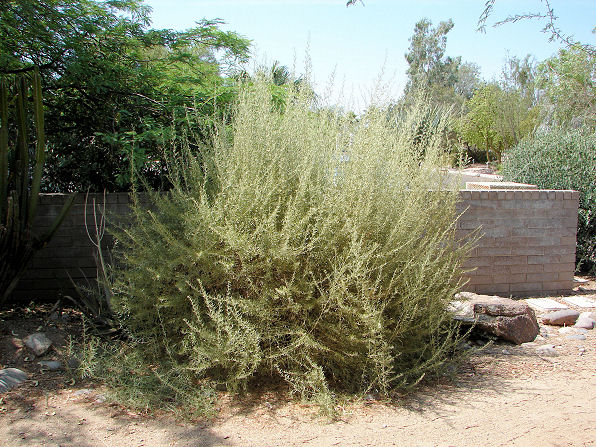 |
| Fourwing Saltbush, Atriplex canescens. Photo June 28, 2006. Glendale Xeriscape Demonstration Garden. |
|---|
 |  |
| Fourwing Saltbush. Atriplex canescens. | Fourwing Saltbush. Atriplex canescens. |
|---|---|
 |  |
| Fourwing Saltbush. Atriplex canescens Female Flowers. | Fourwing Saltbush. Atriplex canescens Male Flowers. |
 |  |
| Four Wing Saltbush. Atriplex canescens Winged Fruit. | Fourwing Saltbush. Atriplex canescens Winged Fruit. |
 /
/


Fourwing Saltbush.
We wish to thank Wikipedia, the free encyclopedia for some of the information on this page. We share images and information with Wikipedia. An erect, stout, and many - branched perennial evergreen shrub, growing 1 to 7 feet tall, and 1 to 15 feet in diameter. It flowers from May to September and reproduces from seed. Fourwing saltbush is well adapted to a wide range of temperature and soil conditions. It is highly tolerant of drought, salinity, and alkalinity. Fourwing saltbush occurs on sand dunes, in gravelly washes, on mesas, ridges, alluvial plains, and slopes, at elevations between 3,000 and 8,000 feet. Prefers many different soil types, most common on deep, well - drained, sandy (often alkaline) soils in the desert and foothill ranges of the Great Basin. It also grows well on heavy clay asoil. Fourwing saltbush is a valuable browse that tolerates heavy use. It is used extensively by many wildlife species and domestic livestock. Native Americans ground the seeds to make flour for bread. The pollen of Fourwing Saltbush often causes hay fever.
Quick Notes:
Height: 1 to 7 feet tall, and 1 to 15 feet in diameter.
Trunk: Up To About 10 inches thick.
Bark: The bark is a light grey.
Flowers: Flowers occur in panicles. Male and female flowers are usually borne on separate plants. The male flowers grow in dense clusters arranged as spike-like branches in a terminal panicle and are green in color.
Female flowers grow in short axillary spikelets, appearing as a terminal panicle, yellow in color.
Flowering Time: May to September.
Fruit & Seeds: A utricle, enclosed in a pair of 2-winged bracts, giving it the "fourwing" appearance.
Trunk: Up To About 1 1/2 Foot Thick. A single trunk with arm-like branches and old dry leaves left in place.
Leaves: Alternate or occurring in fascicles (like pine needles). Blades are oblong to wide oval to lance-shaped, 3/8 inch wide and 2 inches long.
Margins are entire and may be rolled. The surfaces are thick gray and scurfy.
Found: Native to the United States; (AZ, CA, CO, ID, KS, MT, ND, NE, NM, NV, OK, OR, SD, TX, UT, WA, WY). Also native to Canada (AB). Also native to northern Mexico in northern Sonora, northern Chihuahua, Baja Norte, Baja California, & Coahuila.
Hardiness: Most is found in zones 9b to 4a.
Soil pH requirements:
Sun Exposure:
Elevation: 0 - 8,000 Feet. Naturally, most is found between 3,000 - 8,000 feet.
Habitat: Sand dunes, in gravel washes, mesas, ridges, alluvial plains, and slopes. Xeriscape Landscaping.
Miscellaneous: Flowering Photos Taken June 28, 2006. Glendale, Arizona Xeriscape Demonstration Garden.
|


We Are Proud Of Our SafeSurf Rating!
Click On Any Of The Following Links By Amazon.Com
For Books, & Videos About Xerioscape Plants Of Arizona & The Southwest USA. No Obligation!
Back To Arizona Wild Flowers Home Page.
Back To Arizona Wild Flowers, Other Flowers Page Two.
Back To Arizona Xeriscape Landscaping Main Page.
Back To Xeriscape Shrubs Page Five.
Back To DeLange Home Page
© 1966 - Present, Audrey, Eve, & George DeLange
| © 1966 - Present, Audrey, Eve, & George DeLange |